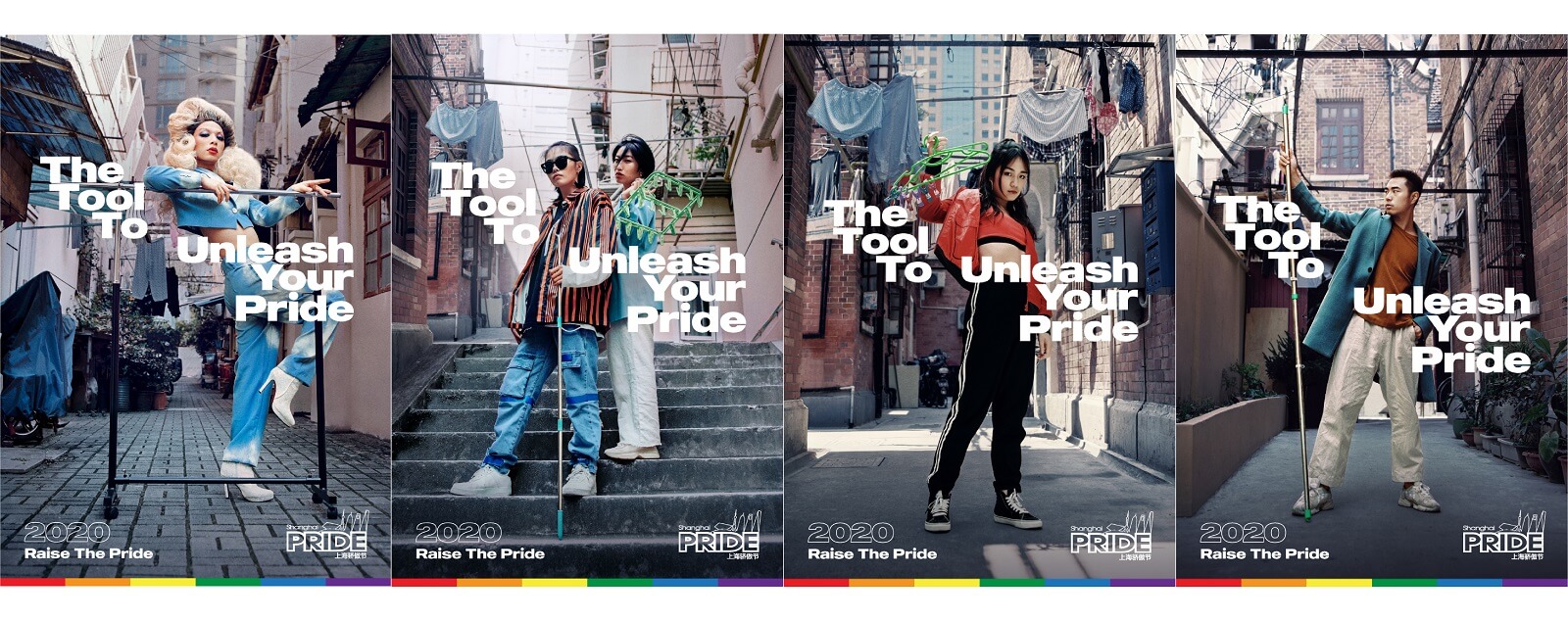

ShanghaiPRIDE presents Queer Talks #2: Bisexual Invisibility: Impacts and Recommendations
When: Sunday 12April2015 5:30pm
Where: Cambio Coffee – 861 Jiangning Lu near Haifang Lu
Entry: Free if RSVP [email protected]
~爱予未来 Love is Our Future~

Bisexuality is the capacity for emotional, romantic, and/or physical attraction to more than one sex or gender. A bisexual orientation speaks to the potential for, but not requirement of, involvement with more than one sex/gender.
Bisexuals experience high rates of being ignored, discriminated against, demonized, or rendered invisible by both the heterosexual world and the lesbian and gay communities. Often, the entire sexual orientation is branded as invalid, immoral, or irrelevant. Despite years of activism and the largest population within the LGBT community, the needs of bisexuals still go unaddressed and their very existence is still called into question. This erasure has serious consequences on bisexuals’ health, economic well-being, and funding for bi organizations and programs.
In spite of the overwhelming data that bisexuals exist, other people’s assumptions often render bisexuals invisible. Two women holding hands are read as “lesbian,” two men as “gay,” and a man and a woman as “straight.” In reality, any of these people might be bi―perhaps all of them.
While bisexuality has often been considered merely a “phase” en route to a stable gay or lesbian orientation, it is also a stable sexual orientation in itself. A longitudinal study of sexual minority women (lesbian, bisexual, or unlabeled) found that over 10 years, “more women adopted bisexual/unlabeled identities than relinquished them.”
Bisexuals find themselves erased in history. Many famous people―such as Freddie Mercury or Eleanor Roosevelt, and Walt Whitman―have been labeled as lesbian or gay for their same-sex relationships, yet their long-term relationships with different-sex partners are ignored or their importance minimized. This disrespects the truth of their lives for the sake of a binary conception of sexual orientation. It also makes it more difficult for bisexuals just coming out to find role models.
Often, the word “bisexual” shows up in an organization’s name or mission statement, but the group doesn’t offer programming that addresses the specific needs of bisexuals. Even when an organization is inclusive, the press and public officials often fall back on the “safety” of saying just “gay and lesbian.” There is even a growing trend of talking about the “gay, lesbian, and transgender” community or “lesbian, gay, and transgender” movement. But words matter. Invisibility matters.
Bisexual invisibility is one of many manifestations of biphobia. Others include:
– Assuming that everyone you meet is either heterosexual or homosexual.
– Supporting and understanding a bisexual identity for young people because you identified “that way” before you came to your “real” lesbian/gay/heterosexual identity.
– Automatically assuming romantic couplings of two women are lesbian, or two men are gay, or a man and a woman are heterosexual.
– Expecting a bisexual to identify as gay or lesbian when coupled with the “same” sex/gender or as heterosexual when coupled with the “opposite”.
– Believing that bisexual men/women spread HIV/AIDS to heterosexuals.
– Thinking bisexual people haven’t made up their minds.
– Refusing to accept someone’s self-identification as bisexual if the person hasn’t had sex with both men and women.
– Feeling bisexuals just want to have their cake and eat it too.
– Assuming a bisexual person would want to fulfill your sexual fantasies or curiosities.
– Thinking bisexuals only have committed relationships with “opposite” sex/gender partners.
– Assuming that bisexuals, if given the choice, would prefer to be in an “opposite” gender/sex coupling to reap the social benefits of a so-called “heterosexual” pairing.
– Believing bisexuals are confused about their sexuality.
– Refusing to use the word bisexual in the media when reporting on people attracted to more than one gender.
– Using the terms “phase” or “stage” or “confused” or “fence-sitter” or “bisexual” or “AC/DC” or “switch-hitter” as slurs or in an accusatory way.
– Assuming bisexuals are incapable of monogamy.
– Feeling that bisexual people are too outspoken and pushy about their visibility and rights.
– Looking at a bisexual person and automatically thinking of her/his sexuality rather than seeing her/him as a whole, complete person. Assuming bisexual means “available.”
– Not confronting a biphobic remark or joke for fear of being identified as bisexual.
– Thinking that bisexual people will have their rights when lesbian and gay people win theirs.
Adapted from Bisexual Invisibility: Impacts and Recommendations by San Francisco Human Rights Commission.
Online:
http://www.birequest.org/docstore/2011-SF_HRC-Bi_Iinvisibility_Report.pdf


